
Under California Health and Safety Code 11375.5 HS, it's a crime for someone to sell or give synthetic stimulants to another person or to use or possess them. A conviction for this misdemeanor carries up to six months in county jail and a fine of up to $1,000.
California laws are not only strict against the sale and use of controlled substances but also synthetic substances that are designed to mimic real drugs and are often unsafe to consume.
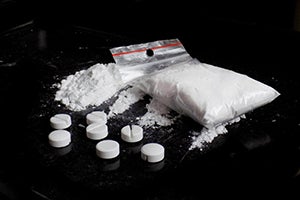
HS 11375.5 says, "(a) Every person who sells, dispenses, distributes, furnishes, administers, or gives, or offers to sell, dispense, distribute, furnish, administer, or give, any synthetic stimulant compound specified in subdivision (c), or any synthetic stimulant derivative, to any person, or who possesses that compound or derivative for sale, is guilty of a misdemeanor, punishable by imprisonment in a county jail not to exceed six months, or by a fine not to exceed one thousand dollars ($1,000), or by both that fine and imprisonment.
(b) Every person who uses or possesses any synthetic stimulant compound specified in subdivision (c), or any synthetic stimulant derivative, is guilty of a public offense, punishable as follows:
(1) A first offense is an infraction punishable by a fine not exceeding two hundred fifty dollars ($250).
(2) A second offense is an infraction punishable by a fine not exceeding two hundred fifty dollars ($250) or a misdemeanor punishable by imprisonment in a county jail not exceeding six months, a fine not exceeding five hundred dollars ($500), or by both that fine and imprisonment.
(3) A third or subsequent offense is a misdemeanor punishable by imprisonment in a county jail not exceeding six months, a fine not exceeding one thousand dollars ($1,000), or by both that fine and imprisonment.
(c) Unless specifically excepted or contained within a pharmaceutical product approved by the United States Food and Drug Administration, or unless listed in another schedule, subdivisions (a) and (b) apply to any material, compound, mixture, or preparation which contains any quantity of a substance or analog of a substance, including its salts, isomers, esters, or ethers, and salts of isomers, esters, or ethers whenever the existence of such salts, isomers, esters, or ethers, and salts of isomers, esters, or ethers is possible, that is structurally derived from 2-amino-1-phenyl-1-propanone by modification in one of the following ways:
(1) By substitution in the phenyl ring to any extent with alkyl, alkoxy, alkylenedioxy, haloalkyl, or halide substituents, whether or not further substituted in the phenyl ring by one or more other univalent substituents.
(2) By substitution at the 3-position with an alkyl substituent.
(3) by substituting the nitrogen atom with alkyl or dialkyl groups or by including the nitrogen atom in a cyclic structure.
(d) This section shall not prohibit prosecution under any other provision of law."
What Is a Synthetic Stimulant?
Synthetic stimulants (designer drugs) are chemically engineered substances that are specifically designed to mimic the effects of traditional stimulants, such as cocaine or methamphetamine.
Notably, these synthetic substances are called various names, such as the following:
- Bath salts,
- Plant food or
- Research chemicals.
These synthetic substances are often labeled as 'not for human consumption' in an attempt to circumvent legal restrictions, highlighting the deceptive nature of their marketing.
Synthetic stimulants can be ingested by snorting, smoking, or injecting. They are unpredictable and can have dangerous side effects on users, such as the following:
- Elevated heart rate and blood pressure.
- High anxiety and paranoia.
- Extreme agitation and restlessness.
- Hallucinations.
- In severe cases, death may result.
What Acts Does the Law Prohibit?
HS 11375.5 creates two primary crimes related to synthetic stimulants, including the following:
- Possession and Use: HS 11375(b) makes it illegal to use or possess synthetic stimulants, including actual possession (on your person) or constructive possession (within your reach or control).
- Sale and Possession for Sale: HSC 11375.5(a) makes it a misdemeanor offense to sell, dispense, distribute, furnish, administer, or offer to do any of these activities with synthetic stimulants or any derivative of these substances. This is called "possession of synthetic stimulants for sale."
What are the Common Synthetic Stimulants?
While there are others, the most common synthetic stimulants include the following:
- Mephedrone: This synthetic stimulant is called "meow meow" and produces effects similar to ecstasy.
- Alpha-PVP (Flakka): This synthetic stimulant causes harsh side effects, such as hallucinations and aggressive behavior.
- MDPV (Methylenedioxypyrovalerone): This synthetic stimulant is widely known for its intense stimulant effects similar to methamphetamine.
What Must Be Proven to Convict?
To convict you for violating HS 11375.5, the district attorney (prosecution) must prove several elements of the crime beyond a reasonable doubt, such as the following:
- You knew the substance was a synthetic stimulant.
- You intended to sell, distribute, or furnish the synthetic stimulant OR
- You possessed the synthetic stimulant.
- You deliberately acted to sell, offer to sell, or possess the substance.
- The synthetic stimulant was either on your person or under your control.
What are Related Laws?
- Health and Safety Code 11366 HS - Operating or maintaining a drug house. This statute prohibits operating or maintaining any place to sell or give away illegal controlled substances unlawfully. This wobbler can be filed as a misdemeanor or felony, which carries up to three years in jail and a fine of up to $10,000.
- Health and Safety Code 11357.5 HS - Sale of synthetic cannabis. This statute makes it a crime to sell or give somebody synthetic cannabis or use or possess it. This infraction or misdemeanor crime is punishable by up to six months in county jail and a fine of up to $1,000.
- Health and Safety Code 11352 HS - Sale or transportation of a controlled substance. This statute makes it a crime to sell or transport certain controlled substances, such as cocaine and heroin, and commonly prescribed opiates, such as codeine, oxycodone (Oxycontin), and hydrocodone (Vicodin). This felony carries three to nine years in jail and a fine of up to $20,000.
- Health and Safety Code 109575 HS - Manufacture of imitation controlled substances. This law makes it a crime to manufacture, distribute, or possess an imitation controlled substance knowingly or with the intent to distribute it.
What Are the Penalties?
The penalties for violating HS 11375.5 will vary based on the case details, such as discussed below.
The sale or possession for sale of synthetic stimulants is a misdemeanor offense that carries Up to 6 months in jail and Fines of up to $1000.
Possession and use of synthetic stimulants is either an infraction or a misdemeanor, depending on the following:
- First-offense personal use carries a fine of up to $250.
- Second personal is an infraction or misdemeanor and can carry up to six months in county jail and a fine of up to $500.
- Third or subsequent offenses is a misdemeanor that carries up to six months in county jail and a fine of up to $1,000.
What Are the Legal Defenses?
A California criminal defense attorney can use different strategies to challenge an alleged violation of HS 11375.5 sale of synthetic stimulants, as discussed below.

Perhaps we can argue that you were unaware the substance was a synthetic stimulant. Perhaps we can demonstrate no intent to sell or distribute the substance.
In simple possession cases, perhaps we can argue that while the substance may have been within your reach, you did not possess or control it. Perhaps someone left the stimulant in your car without your knowledge.
Perhaps we can argue the substance in question does not meet the statute's definition of a synthetic stimulant.
Perhaps law enforcement did not have probable cause to search you or your belongings; it violates your Fourth Amendment rights. If you can show unlawful search and seizure, any evidence gathered might be suppressed, and the charges may be dismissed.
For additional information, contact our criminal defense law firm, Cron, Israels & Stark, based in Los Angeles, CA.
Related Content:
