
California Penal Code 20510 - Cane Swords Law
A cane sword appears to be a regular walking cane but conceals a sword inside. These canes are often very decorative.
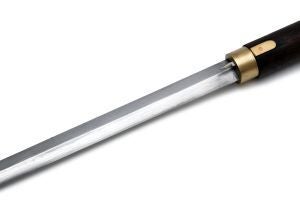
In California, cane swords are classified as prohibited weapons. Though they resemble ordinary canes, they contain a sharp blade hidden within. Possessing a cane sword can result in criminal charges.
Cane swords are prohibited in California according to Penal Code 20510 PC, which makes it a crime to manufacture, sell, import, give, or possess them. Examples of illegal activities include:
- Using a cane sword as a standard cane.
- Purchasing a cane and inserting a sword into it.
- Purchasing a cane sword outside California and then transporting it into the state.
Penal Code 20510 PC states, "anyone in this state who manufactures, or causes it, imports into the state, keeps for sale, or offers or exposes for sale, or gives, lends, or has possession of any cane sword is punishable by county jail imprisonment not exceeding one year under subdivision (h) of Section 1170."
As noted above, cane swords are classified as generally prohibited weapons under California law. This regulation is outlined in California Penal Code 16590 PC. Our California criminal defense attorneys will explore this law in more detail below.
What are the Potential Penalties If Convicted?
Possessing a cane sword is classified as a wobbler offense under California law.
Wobblers are crimes that can be prosecuted as either misdemeanors or felonies, with the decision made by the prosecutor based on the case details.
If the court charges the possession of a cane sword as a misdemeanor, it can impose the following penalties:
- Up to one year in jail, and
- A fine of up to $1,000 may be imposed following a conviction.
The court has the authority to assign a defendant to misdemeanor probation instead of jail. However, if the prosecutor charges possession of a cane sword as a felony, then the court can impose the following sentence:
- up to three years in prison, and
- A fine of up to $10,000 can be imposed upon conviction.
The court may impose felony probation on a defendant as an alternative to incarceration in jail or prison.
Is it Possible to Have This Crime expunged?
Yes, but only if the conviction is classified as a misdemeanor. Under California Penal Code 1203.4 PC, a conviction for possessing a cane sword can be expunged.
However, only misdemeanor convictions are eligible for expungement; felony convictions cannot be expunged under California law. Therefore, if the case resulted in a felony conviction for possession of a cane sword, it cannot be expunged in California.
What Are the Related Laws?
In California, various criminal offenses pertain to possessing cane swords. Typical crimes involve illegal possession of items such as switchblades, brass knuckles, nunchucks, shobi-zue, lipstick case knives, or shurikens. These are defined as:
- Penal Code 21510 PC - possession of a switchblade knife
- Penal Code 21810 PC - possession of brass knuckles
- Penal Code 22010 PC - possession of nunchucks
- Penal Code 22610 PC - stun guns and tasers law
- Penal Code 33600 PC - zip gun law
- Penal Code 16470 PC - carrying a dirk or dagger
- Penal Code 17330 PC - wallet gun
- Penal Code 21110 PC - ballistic knife
- Penal Code 20610 PC - lipstick case knife
- Penal Code 20410 PC - belt buckle knives
- Penal Code 20710 PC - possession of a shobi-zue
- Penal Code 22410 PC - possession of shurikens
- Penal Code 14410 PC - possession of a cane gun
- Penal Code 4502 PC - weapons in penal facility
- Penal Code 24610 PC - Undetectable firearms
All charges mentioned above are wobbler offenses, which can lead to up to one year in county jail and a maximum fine of $1,000 if classified as a misdemeanor, or up to three years in prison and a fine of up to $10,000 if considered a felony.
What Defenses Are Available?
Multiple defenses can be used to contest a charge of possessing a cane sword. Typical defenses include:
- The object in question does not qualify as a cane sword according to the statutory definition in Penal Code 16340 PC.
- The defendant did not own a cane sword.
- The defendant is not subject to prosecution under Penal Code 20510 PC.
- Law enforcement obtained the cane sword illegally; or
- The police used force or intimidation to obtain the confession.
If the police collect evidence unlawfully, a judge can exclude it from the case following a defense motion. Excluding such evidence often results in case dismissal.
Similarly, if law enforcement used excessive methods to pressure a confession, this misconduct could be used as a legal defense. Demonstrating that you were coerced into confessing might lead to the charges being dropped.
Engaging our law firm early in the case can improve your chances of a positive result, possibly allowing us to negotiate with law enforcement and prosecutors to avoid formal criminal charges. Contact Cron, Israels & Stark for a case evaluation.