
Vehicle Code 23152(e) VC - DUI by Uber, Lyft, or Taxi
California Vehicle Code 23152(e) VC addresses the crime of driving under the influence (DUI) with a passenger for hire in a vehicle driven for commercial purposes, often called 'DUI by ride-sharing driver."
This law section is essential for drivers who transport passengers, such as those working for limousine companies, taxi services, and ride-sharing companies like Uber and Lyft.
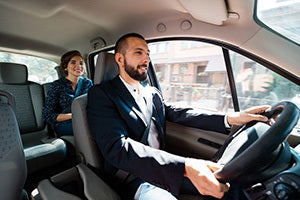
Under this law, drivers face penalties that can significantly impact their professional and personal lives. Our Los Angeles DUI attorneys defend people accused of DUI offenses, so we understand the profound nature of cases involving passengers for hire.
If you face charges, we can review your situation and explain how we can navigate them for you and achieve the best possible outcome. Simply put, VC 23152(e), DUI with a passenger for hire law makes it unlawful for a driver to drive a motor vehicle while under the influence of alcohol or drugs while transporting a passenger in that vehicle.
The blood alcohol content (BAC) limit for adult commercial drivers who are 21 or over, which is the legal drinking age, is 0.04%, which is half the legal limit for non-commercial adults, which is 0.08%.
California law attempts to protect passengers who hire commercial drivers to transport them. It also enforces the responsibility these drivers have to keep their customers safe.
A police officer can require drivers lawfully under arrest to take a DUI breath test, a DUI blood test, or a urine test to determine their level of intoxication. The test can occur within three hours of driving.
Any driver who refuses to take a breathalyzer test or decline another kind of DUI chemical test in California could face additional penalties, including driver's license suspension or revocation.
Notably, all drivers in California give implied consent to such testing when they accept a driver's license and drive on public roads. This means that by driving, you are agreeing to these tests if an officer has reasonable cause to believe you are driving under the influence.
DUI By Ride Share Driver - Quick Facts
- California Vehicle Code 23152(e) VC defines the DUI "per se" law for taxi, limo, and ride-sharing drivers.
- Ride-share drivers cannot drive with a blood alcohol concentration (BAC) of .04% or higher while a paying passenger is in the vehicle.
- Any driver transporting passengers for compensation faces criminal charges if caught with a BAC of 0.04% or higher.
- The .04% legal limit for ride-sharing drivers also applies under California Vehicle Code 23153(e) DUI causing injury law.
- This law makes the legal limit for ride-sharing drivers the same as for commercial drivers.
- California has a legal limit of .08% BAC for most drivers aged 21 and over.
- VC 23152(e) distinguishes ride-share drivers by lowering their legal blood alcohol content (BAC) limit to 0.04% while on duty.
- If you meet or exceed the DUI per se "legal limit" of .04%, it does not matter whether your driving is impaired.
- Driving ability of most people is not significantly impaired at .04 BAC.
- This law ensures greater safety for passengers using commercial transportation services with higher safety expectations.
- A DUI will likely disqualify the driver from earning a living as a driver for hire.
What is a Passenger for Hire?
A "passenger for hire" is someone who is expected to pay for the transportation services of the driver, whether directly to the driver or indirectly to the company they work for.
All ride-share drivers are considered "on duty" when carrying passengers or logging into their ride-sharing apps, indicating their availability. While ride-sharing drivers are "off duty," the standard BAC limit of 0.08% for DUIs applies. This distinction is important as it determines the applicable BAC limit and the potential legal consequences for the driver.
The lowered BAC standards of .04% apply to taxi drivers, limo drivers carrying ten passengers or fewer, and ride-sharing drivers using app-based ride-sharing platforms, such as Uber or Lyft, while on duty.
Reducing the legal BAC limit for ride-sharing drivers highlights California's attempts to improve road safety significantly since ride-sharing services are sharply increasing.
Drivers working for Uber and Lyft must exercise extreme caution in their alcohol consumption before and during work hours. Even a BAC reading of just 0.04% could lead to criminal charges and loss of employment, underscoring the need for responsible behavior.
What are the VC 23152(e) Penalties?
The penalties for violating the passenger-for-hire DUI law in California are similar to the standard DUIs. If convicted, the penalties can include the following:
- Fines between $390 to $1,000.
- Up to six months in jail for first-time offenders.
- Repeat offenders will face increased penalties.
- CA DMV driver's license suspension for at least six months.
- Attend a state-approved "DUI school" course for 3-9 months. This course is designed to educate and rehabilitate individuals who have been convicted of DUI. It covers topics such as the dangers of driving under the influence, the effects of alcohol and drugs on driving, and strategies for avoiding future DUI offenses.
- 30 months DUI school for repeat offenses.
- Drivers could be on probation for three to five years.
- Drivers might be required to compensate injured parties for their losses.
- The DMV might allow a convicted driver to continue driving with a restricted license but have an ignition interlock device (IID) installed in the vehicle.
- Under California law, ride-sharing companies cannot hire anyone convicted of DUI within the past seven years.
What Are Related Laws?
Several California laws are related to Vehicle Code 23152(e), which can be filed as additional charges, such as the following:
- Vehicle Code 23152(a) VC - Driving under the influence of alcohol or drugs. It's a crime to operate a motor vehicle while impaired by drugs, alcohol, or both together, regardless of the BAC level.
- Vehicle Code 23153 VC - DUI Causing Injury. This law applies if someone driving under the influence commits an act or neglects a duty of care and causes another person bodily injury.
- Penal Code 273(a) VC Child Endangerment. If there was a minor in the car at the time of the DUI, you might have compromised their safety due to your impairment.
- Vehicle Code 20001(a) VC - Hit and Run Involving Injury or Death. This involves an accident and leaving the scene without providing contact information or assisting the injured.
- Penal Code 191.5(b) VC - Vehicular Manslaughter While Intoxicated. This involves a DUI case that results in death or gross vehicular manslaughter while intoxicated could be filed.
- Vehicle Code 23103 VC - Reckless Driving. This involves your behavior behind the wheel displaying a disregard for the safety of persons or property; they might be charged with reckless driving.
- Vehicle Code14601.1(a) VC - Driving on a Suspended License. This law involves driving on a suspended or revoked license due to a previous DUI or other reasons; additional charges can be filed.
What are the VC 23152(e) Defenses?
Our California criminal defense attorneys can use several strategies to challenge Vehicle Code 23152(e) DUI by ride-share driver, including the following:
- If the initial traffic stop or arrest was conducted without probable cause, it might be possible to have the evidence dismissed.
- If police fail to calibrate breathalyzer devices or follow standardized procedures properly, the BAC results might be inaccurate.
- Field sobriety tests are subjective and can produce false positives due to nerves, fatigue, or medical issues.
- If the driver was not operating in a passenger-for-hire capacity during the arrest, they could avoid the lower BAC limit's applicability.
- Some medical conditions can mimic signs of intoxication or cause false BAC readings, such as diabetes.
- "Dry reckless" as a plea bargain to DUI charges for lesser penalties.
For more information, contact Cron, Israels & Stark, a Los Angeles criminal defense law firm.
What Does the Law Say?
California Vehicle Code 23152 VC says, "(a) It is unlawful for a person under the influence of any alcoholic beverage to drive a vehicle.
(b) It is unlawful for a person who has 0.08 percent or more, by weight, of alcohol in his or her blood to drive a vehicle.
For purposes of this article and Section 34501.16, percent, by weight, of alcohol in a person's blood is based upon grams of alcohol per 100 milliliters of blood or grams of alcohol per 210 liters of breath.
In any prosecution under this subdivision, it is a rebuttable presumption that the person had 0.08 percent or more, by weight, of alcohol in his or her blood at the time of driving the vehicle if the person had 0.08 percent or more, by weight, of alcohol in his or her blood at the time of performing a chemical test within three hours after the driving.
(c) It is unlawful for a person who is addicted to the use of any drug to drive a vehicle. This subdivision shall not apply to a person who is participating in a narcotic treatment program approved under Article 3 (commencing with Section 11875) of Chapter 1 of Part 3 of Division 10.5 of the Health and Safety Code.
(d) It is unlawful for a person who has 0.04 percent or more, by weight, of alcohol in his or her blood to drive a commercial motor vehicle, as defined in Section 15210. In a prosecution under this subdivision, it is a rebuttable presumption that the person had 0.04 percent or more, by weight, of alcohol in his or her blood at the time of driving the vehicle if the person had 0.04 percent or more, by weight, of alcohol in his or her blood at the time of the performance of a chemical test within three hours after the driving.
(e) Commencing July 1, 2018, it shall be unlawful for a person who has 0.04 percent or more, by weight, of alcohol in his or her blood to drive a motor vehicle when a passenger for hire is a passenger in the car at the time of the offense.
For purposes of this subdivision, "passenger for hire" means a passenger for whom consideration is contributed or expected as a condition of carriage in the vehicle, whether directly or indirectly flowing to the owner, operator, agent, or any other person interested in the vehicle. In a prosecution under this subdivision, it is a rebuttable presumption that the person had 0.04 percent or more, by weight, of alcohol in his or her blood at the time of driving the vehicle if the person had 0.04 percent or more, by weight, of alcohol in his or her blood at the time of the performance of a chemical test within three hours after the driving.
(f) It is unlawful for a person who is under the influence of any drug to drive a vehicle.
(g) It is unlawful for a person who is under the combined influence of any alcoholic beverage and drug to drive a vehicle."