
To obtain a long-term restraining order in California, you must provide evidence of specific acts of harassment, threats, or abuse, such as photographs, text messages, emails, and proof of injuries. You will also need to submit written statements and possibly have third-party witnesses who can support your case during the court hearing.
Restraining orders, often issued in domestic violence cases, have serious long-term effects. They can impose strict limits on your ability to move freely, engage socially, and even restrict your right to own firearms.

Given the severity of these consequences, it is crucial to understand the legal procedures and evidence required fully. This understanding will empower you to navigate the process effectively and protect your rights.
If you are accused of domestic violence and facing a restraining order in California, understanding the legal standards and the kinds of evidence that can be used against you is crucial.
This knowledge not only helps you gather and present evidence to counter the allegations but also ensures you receive a fair hearing, instilling confidence in the legal process.
While temporary restraining orders require minimal evidence and are difficult to contest before they expire, your accuser must provide more concrete proof to persuade a judge to issue a longer-term domestic violence restraining order.
At the hearing, it is highly advisable to have an attorney by your side. Their guidance and support will be invaluable as you respond to the evidence presented against you.
Key Takeaways
- Many individuals involved in filing or defending a restraining order are often unaware of the evidence required for approval.
- Understanding the different standards of proof used by a judge in a restraining order case is crucial. This knowledge guides you in preparing your defense and ensures that you are not caught off guard during the proceedings.
- In California, anyone can file court documents for a temporary restraining order, usually processed the same day in Los Angeles.
- The person seeking the order is called the "Petitioner." They must submit sworn statements about any incidents of abuse or harassment.
- Whether it's a domestic violence or civil restraining order, the court requires a description of abuse, including physical or emotional.
- The judge will examine the requested order along with any other individuals it seeks to protect. Their responsibility is to impartially evaluate the evidence and make a decision based on legal criteria and the facts presented.
- A civil restraining order is issued to those who do not have a qualifying relationship for a domestic violence order.
- Civil cases often involve neighbors, co-workers, or business partners. Since the relationship between the parties is usually less substantial than that of spouses or family members, the court requires a much stronger level of evidence.
Proof of a Temporary Restraining Order
The process usually begins with the petitioner-the individual alleging abuse or harassment—filing a request for a Temporary Restraining Order (TRO). In California, the standards for granting a TRO are relatively low, and the respondent—who is accused—often does not need to be present to contest the order.
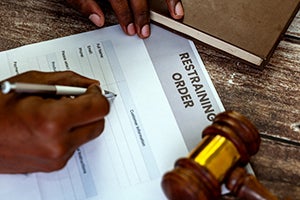
To get a TRO, the petitioner usually only needs to submit sworn statements describing the alleged abuse or harassment. These statements are the main evidence upon which the judge bases the decision to issue a TRO.
At this stage, the standard of proof is "reasonable proof," meaning the petitioner needs only to demonstrate that it is reasonable to believe that abuse or harassment occurred.
After the TRO is issued and you receive it, you must comply with its terms right away. Breaking a TRO can result in criminal charges, including fines and jail time, and may also negatively affect your case during the final restraining order hearing.
A TRO is designed to provide immediate, short-term protection and remains in effect until the court conducts a hearing, typically within 22 days, to determine whether a final restraining order should be granted.
Evidence Supporting a Final Domestic Violence Restraining Order
The main challenge occurs during the restraining order hearing, where the court decides whether to issue a Domestic Violence Restraining Order (DVRO). Unlike a Temporary Restraining Order (TRO), which offers immediate short-term protection, a DVRO typically remains in effect for 3 to 5 years.
The standard of proof for issuing a final DVRO is higher than that for a TRO. The judge assesses whether domestic violence occurred based on a "preponderance of the evidence," which means they must determine it is more likely than not (51% or more) that the alleged abuse took place.
Although this standard of proof is still much lower than the "beyond a reasonable doubt" standard in criminal cases, it allows you, as the defendant, to contest the evidence against you and to provide proof that clears you.
Burden of Proof in a Civil Restraining Order Case
To secure a permanent civil restraining order, the petitioner must demonstrate their allegations to the court using "Clear and Convincing" evidence. This standard requires evidence that is more persuasive than mere statements. Anyone pursuing such an order should be ready to provide some evidence beyond their written statements and courtroom testimony.

This standard requires the court to review photographs, text messages, e-mails, or any other physical evidence supporting the petitioner's claims. The court will not consider a mere exchange of allegations.
The petitioner should present concrete examples of harassment, threats, or physical harm as proof. Generally, these incidents need to happen over a period to establish a pattern of harassment by the accused.
Often, third-party witnesses are the most persuasive evidence in contesting or obtaining a restraining order. A witness with minimal ties to either party and no personal interest in the case's outcome can significantly influence the Judge.
Third-party witnesses often struggle to appear in court unless they are subpoenaed. However, without additional evidence beyond the petitioner's testimony, securing a restraining order can be challenging.
What Evidence Is Considered in a Domestic Violence Case?
During the restraining order hearing, your accuser can present different types to support their claims. Knowing these can help you prepare your defense. Typical evidence includes:
- Text Messages and Emails: These can uncover threatening language or harassment patterns. Screenshots or printed copies might be used as evidence of communication.
- Photos: Images showing physical injuries or property damage can effectively back up claims of abuse.
- Witnesses: Statements from those who have witnessed domestic violence or understand the relationship dynamics can be compelling.
- Medical Records: Documenting injuries caused by domestic violence can strengthen the petitioner's case.
- Police Reports: If law enforcement has been involved, their reports may serve as strong evidence outlining incidents and the measures taken.
How to Respond to a Domestic Violence Restraining Order
Suppose you've been accused of domestic violence and face a potential restraining order. In that case, it's important to realize that these cases tend to be very emotional, and the evidence might not always be straightforward.
Having a final DVRO issued against you can have serious consequences, impacting your personal, professional, and financial life.
The best way to avoid these effects is to hire a skilled attorney who can challenge unfair evidence at your restraining order hearing and introduce counter-evidence to support your case. Examples of how this may play out include:
- Showing discrepancies in the petitioner's statements or presented evidence.
- Offering witness testimonies that oppose the petitioner's claims.
- Demonstrating a pattern of the petitioner making false accusations.
- Providing evidence of self-defense or mutual combat, if relevant
Contact our Los Angeles domestic violence defense attorneys for more information. Cron, Israels & Stark is located in Los Angeles, CA.
Related Content:
