
While the First Amendment to the U.S. Constitution guarantees the right to peaceful assembly and free speech, California law draws a strict line when public demonstrations cross into attempts to influence judicial outcomes.
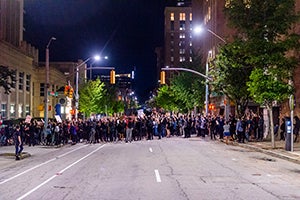
Under California Penal Code § 169 PC, it is a criminal offense to picket, parade, or demonstrate in or near a courthouse with the specific intent to obstruct justice or sway judges, jurors, witnesses, or court officers.
This law balances the right to protest with the constitutional mandate to ensure fair, impartial, and uncoerced judicial proceedings.
What Is the Legal Definition of PC 169?
California Penal Code § 169 PC criminalizes targeted courthouse picketing intended to disrupt judicial proceedings or pressure participants in a case.
"Any person who pickets or parades in or near any building housing any court of this state, with the intent to interfere with, obstruct, or impede the administration of justice, or with the intent to influence any judge, juror, witness, or officer of the court, in the discharge of his duty, is guilty of a misdemeanor."
What Are the Key Statutory Definitions Under PC 169?
Understanding the core legal terms helps clarify the boundary between constitutionally protected free speech and criminal interference:
-
Picket or Parade: Demonstrating, marching, displaying signs, holding banners, chanting, or gathering in groups in a manner designed to draw public attention.
-
In or Near a Courthouse: Positioned directly inside, on the steps, along the sidewalks, or within immediate proximity to a facility housing state judicial proceedings.
-
Specific Intent to Influence or Obstruct: The deliberate purpose to pressure, intimidate, or persuade a judge, juror, witness, or court officer regarding a pending case, or to impede normal court operations.
What Must Be Proven to Convict Someone Under Penal Code § 169 PC?
To secure a conviction under PC 169, prosecutors must establish each of the following elements beyond a reasonable doubt:
-
Protest Conduct: The defendant picketed, paraded, or actively demonstrated.
-
Statutory Location: The demonstration occurred in or near a building housing a California state court.
-
Corrupt / Disruptive Intent: The defendant acted with the specific intent either to interfere with, obstruct, or impede the administration of justice OR to influence a judge, juror, witness, or court official in performing their official duties.
What Are the Penalties for Penal Code § 169 Violations?
California Penal Code § 169 PC is a misdemeanor offense. Judges may grant first-time offenders summary probation instead of jail time, provided they meet specific court terms.
|
Offense Classification |
Custody & Sentence Limits |
Financial Penalties & Outcomes |
| Standard Misdemeanor PC 169 | Up to 6 months (180 days) in county jail | Up to $1,000 fine plus penalty assessments, community service, and restraining orders. |
| Summary Probation Alternative | 0 days in custody (Jail sentence stayed during probation) | Court-ordered fees, stay-away orders from courthouse grounds, and community labor. |
| Pre-Trial Diversion / Dismissal | No jail time upon program completion | Diversion administrative costs; leads to full dismissal of charges and no conviction. |
What Defense Strategies Are Used Against PC 169 Charges?
Defense attorneys utilize strong constitutional and factual defenses to defeat charges under Penal Code § 169 PC:
-
Protected First Amendment Speech / General Advocacy: Demonstrating that the protest was a general political demonstration (e.g., protesting systemic legal policies) rather than an attempt to target or influence a specific active trial.
-
Lack of Specific Intent: Proving the defendant had no desire to sway a judge or juror or block access, such as a passerby who inadvertently walked through an active demonstration.
-
Location / Public Forum: Showing that the protest took place on public property outside the prohibited zone without blocking entrances, walkways, or court operations.
-
Lack of Probable Cause: Showing that law enforcement arrested the peaceful demonstrator without objective evidence of unlawful intent or illegal obstruction.
How Does Penal Code § 169 Apply in a Real-World Scenario?
Hypothetical Example:
A high-profile criminal trial is underway at a county courthouse. Demonstrators opposing the defendant gather directly outside the courthouse doors, blocking jurors and witnesses from entering. The group holds signs calling on the jury to "Convict Him Now" and chants directly toward the courtroom windows while jurors are seated.
Because the demonstrators specifically targeted seated jurors and physically obstructed court entryways with the intent to influence the verdict, they can be arrested and prosecuted under California Penal Code § 169 PC.
What Related Laws and Statutes Apply to Official Misconduct Cases?
Reviewing related statutory offenses is essential because prosecutors frequently file companion charges or alternative counts in public corruption and protest cases to maximize leverage and capture overlapping criminal acts.
-
California Penal Code § 95 PC (Improper Influence of Jurors): Criminalizes attempting to improperly influence a juror or arbitrator through private threats, promises, or communications.
-
California Penal Code § 136.1 PC (Witness Intimidation): Makes it a felony to knowingly prevent or discourage any witness or victim from giving testimony or attending court proceedings.
-
California Penal Code § 148(a)(1) PC (Resisting or Obstructing an Officer): Penalizes individuals who willfully delay, obstruct, or resist peace officers enforcing courthouse security orders.
-
California Penal Code § 407 & § 408 PC (Unlawful Assembly): Prohibits two or more people from assembling to commit an illegal act or to perform a lawful act in a violent, boisterous, or tumultuous manner.
-
California Penal Code § 415 PC (Disturbing the Peace): Punishes fighting, making unreasonably loud noise, or using offensive language in public to disrupt court business or public safety.
-
California Penal Code § 602.1 PC (Obstructing a Public Business): Prohibits intentionally interfering with or obstructing business open to the public, including municipal and county courts.
Frequently Asked Questions (FAQs)
Is all picketing outside a courthouse illegal in California?
No, peaceful political protests or broad social advocacy outside court buildings are constitutionally protected, provided demonstrators do not attempt to influence an active case or obstruct court entrances.
What is the main difference between Penal Code 169 PC and standard unlawful assembly?
PC 169 specifically requires proof of intent to obstruct justice or influence a judge, juror, or witness, whereas unlawful assembly (PC 407/408) covers general group disturbances regardless of courthouse intent.
Can you be arrested under PC 169 if you did not block any courthouse doors?
Yes, blocking doors is not required; if prosecutors can prove you were picketing near the courthouse with the explicit intent to sway a judge, juror, or witness in an active case, you can be charged.
What happens if you demonstrate after a judicial case is already concluded?
Protesting a verdict or ruling after a trial ends generally does not violate PC 169 because there is no active proceeding or jury left to improperly influence.
Can a conviction for PC 169 PC be cleared through pre-trial diversion?
Yes, first-time offenders accused of misdemeanor courthouse picketing may qualify for California pre-trial diversion programs, which can dismiss charges after you complete community service or counseling.
Learn How We Can Help You
Facing charges under California Penal Code § 169 PC puts your constitutional First Amendment rights, criminal record, and freedom on the line. Our criminal defense team provides strategic representation for individuals facing protest-related allegations and courthouse interference charges:
-
Constitutional & First Amendment Defense: We file aggressive motions to dismiss based on constitutional free speech guarantees, lack of intent, and overbroad law enforcement actions.
-
Video & Body-Cam Evidence Audit: We review security camera recordings, video footage, and officer body-worn cameras to prove your protest was peaceful and non-obstructive.
-
Pre-Trial Diversion Advocacy: We negotiate directly with prosecutors to secure pre-trial diversion or charge reductions, keeping your criminal record completely clean.
The California criminal defense attorneys at Cron, Israels & Stark are here to help you. We are located in Los Angeles, CA. Schedule your consultation today.
