
California Penal Code 18720 PC makes it a serious felony offense to possess substances, materials, or component combinations with the intent to manufacture destructive devices or explosives.
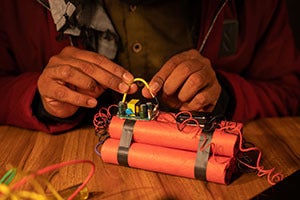
In Los Angeles and throughout Southern California, prosecutors and law enforcement agencies treat allegations involving bomb-making materials with extreme severity due to potential public safety hazards.
Legal Definition and Statutory Text
Under California Penal Code 18720 PC:
"Every person who possesses any substance, material, or any combination of materials or substances, with the intent to unlawfully make or manufacture any destructive device or any explosive, is guilty of a felony."
Key Statutory Definitions
-
Destructive Device Materials: Chemical compounds, explosive powders, fuses, detonators, pipe components, or ordinary substances and household items when possessed with the explicit intent to assemble an unlawful explosive device.
-
Intent to Manufacture: The statute's core mental state; prosecutors must prove you intended to use the materials to build or assemble a destructive device. Completion or full assembly of the device is not required.
-
Constructive or Actual Possession: Control over the materials, whether physically on your person, stored in your residence, kept in a vehicle, or located inside a rented storage unit.
What Must Be Proven to Convict Under PC 18720?
To secure a conviction under Penal Code 18720, the prosecution must establish the following legal elements beyond a reasonable doubt:
-
Possession: You knowingly possessed substances, materials, or components commonly utilized to construct destructive devices.
-
Intent: You harbored the specific intent to use those components to manufacture or assemble an explosive or destructive device.
-
Knowledge: You were consciously aware of the presence and nature of the materials in question.
Hypothetical Examples
-
Example 1: Police execute a residential search warrant and uncover metal pipes, end caps, and loose gunpowder stored together, leading to a PC 18720 charge for possessing pipe-bomb components.
-
Example 2: Law enforcement stops a vehicle and discovers commercial chemical compounds alongside handwritten assembly notes for improvised explosives, triggering destructive device material allegations.
-
Example 3: An individual lawfully purchases ordinary household cleaning supplies and hardware components for legitimate home renovation projects, but is falsely accused of possessing bomb-making materials due to a misunderstanding.
Related California Offenses
Understanding related offenses is critical because prosecutors frequently file multiple interconnected explosives charges or enhancements stemming from the same investigation.
-
California Penal Code 16460 PC (Definition of Destructive Device): Defines what constitutes a bomb, grenade, or incendiary weapon under state law, serving as the statutory baseline for all explosive prosecutions.
-
California Penal Code 18710 PC (Possession of a Destructive Device): Prohibits the actual possession or ownership of a completed destructive device or explosive weapon.
-
California Penal Code 18725 PC (Possession with Intent to Injure or Destroy): Criminalizes possessing destructive devices or explosive materials specifically with the intent to injure people or destroy property, carrying enhanced penalties.
Possible Penalties and Sentencing
Violations of Penal Code 18720 are strictly prosecuted as felonies carrying severe, life-altering consequences:
|
Category |
Primary Penalties |
Collateral Consequences |
| Incarceration | Felony state prison sentences | Permanent criminal record affecting employment, background checks, and housing |
| Fines & Fees | Substantial court-imposed fines up to $10,000 | Lifetime forfeiture and confiscation of seized materials and personal property |
| Probation & Rights | Formal felony probation with strict search conditions | Permanent lifetime loss of firearm ownership, possession, and ammunition rights |
Legal Defenses to PC 18720 Charges
An experienced criminal defense attorney can build a robust defense using several established legal strategies:
-
Lack of Intent: Proving that you possessed ordinary materials for legitimate, lawful purposes (such as academic, industrial, commercial, or hobbyist use) rather than bomb-making.
-
Lawful Possession of Common Materials: Many substances identified by police have valid everyday applications; demonstrating innocent context defeats the prosecution's case.
-
Illegal Search and Seizure: If law enforcement officers discovered materials during an unconstitutional traffic stop, warrantless search, or invalid warrant execution, your attorney can file a suppression motion under Penal Code 1538.5.
-
Lack of Knowledge: Establishing that you were entirely unaware of the presence or nature of the materials located on your property.
Frequently Asked Questions
Is a violation of Penal Code 18720 always charged as a felony in California?
Yes. Possessing destructive device materials with intent to manufacture is prosecuted strictly as a felony offense carrying potential state prison time.
Do prosecutors need to prove that a fully assembled bomb was found?
No. The statute targets the possession of components or materials with the requisite intent; a completed device does not need to be manufactured or recovered for a conviction.
Can ordinary household or industrial items lead to criminal charges?
Yes. If law enforcement believes ordinary items were gathered and organized with the intent to construct an explosive device, prosecutors can file charges under PC 18720.
Can explosive material evidence be suppressed if police violated my rights?
Yes. If your attorney proves that police conducted an unlawful search or seizure in violation of the Fourth Amendment, the court may suppress the evidence, leading to case dismissal.
Will a conviction affect my immigration status?
Yes. Explosive and weapons-related felony convictions can trigger severe immigration penalties, including mandatory deportation, visa revocation, and inadmissibility for non-citizens.
Los Angeles Destructive Device Defense Representation
Facing charges under Penal Code 18720 requires immediate, sophisticated legal intervention. The defense team at Cron, Israels & Stark thoroughly examines forensic evidence, challenges unlawful police searches, and fights to protect your constitutional rights throughout Southern California.
Contact our office today for a confidential case evaluation.
