
If police officers in California do not read your Miranda rights after an arrest, your arrest is not automatically invalidated and your criminal charges are not automatically dismissed.
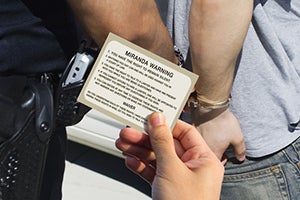
Instead, any statements or confessions you make during a custodial interrogation without first receiving Miranda warnings generally cannot be used against you in the prosecution's main case at trial.
Law enforcement officers must read Miranda warnings only when two specific conditions occur at the same time: you are in police custody and you are subjected to police interrogation.
If officers arrest you and book you into jail without ever questioning you about the alleged crime, no Miranda violation has occurred.
When Are California Police Legally Required to Read Miranda Rights?
Under the Fifth Amendment, Miranda protections apply strictly to custodial interrogation. California courts evaluate both elements based on the totality of the circumstances surrounding the encounter:
|
Element |
Legal Standard in California |
Practical Examples |
| Custody | You are formally under arrest, or your freedom of movement is restricted to the degree associated with a formal arrest. | Being handcuffed, locked in the back of a patrol car, or placed inside a police station interrogation room. |
| Interrogation | Officers ask direct questions or use words and actions they should know are reasonably likely to elicit an incriminating response. | Asking "Where did you hide the gun?" or "How many drinks did you have tonight?" after handcuffing a suspect. |
If either element is missing—for example, if you are briefly detained during a routine traffic stop or voluntarily speak with detectives while free to leave—police are generally not required to read your Miranda rights before asking questions.
How Does a Miranda Violation Affect Your Criminal Case in California?
When law enforcement interrogates an in-custody suspect without reading the Miranda warnings, the primary legal remedy is to suppress the evidence.
Exclusion from the Prosecution's Case-in-Chief
Your criminal defense attorney can file a pretrial motion to exclude any unwarned admissions, confessions, or answers you gave during the unlawful questioning. Once suppressed, the prosecutor cannot introduce those statements to prove your guilt during their main presentation of evidence to the jury.
Impact on Remaining Independent Evidence
Suppressing an unwarned statement does not erase independent evidence police gathered legally. Prosecutors can still move forward with charges using:
-
Eyewitness testimony or 911 recordings.
-
Surveillance footage or body-worn camera video.
-
Physical evidence seized through a valid search warrant or lawful search exception.
-
Blood or breath test results in a DUI investigation.
However, if the prosecution's case relies heavily on your unwarned admission to prove intent, knowledge, or identity, suppressing it often forces the District Attorney to reduce or dismiss the charges.
What Are the Exceptions to the Miranda Rule in California?
Even when a suspect is in custody and questioned without Miranda warnings, California and federal courts recognize several exceptions where statements remain admissible:
-
Spontaneous or volunteered statements: If you blurt out an admission in the back of a patrol car without being prompted or questioned by officers, that statement is admissible because there was no interrogation.
-
Routine booking questions: Officers may ask standard biographical questions—such as your full name, date of birth, address, height, and weight—during jail intake without giving Miranda warnings.
-
Public safety exception: If officers face an immediate threat to public safety—such as locating a discarded firearm in a public place or responding to an active medical emergency—they may ask urgent, targeted questions before reading Miranda rights.
-
Undercover informants: Miranda warnings are not required when an incarcerated suspect voluntarily speaks to an undercover agent or jailhouse informant posing as a fellow inmate, because the coercive atmosphere of a police interrogation is absent.
-
Impeachment at trial: Even if a statement is excluded from the prosecutor's main case because of a Miranda violation, prosecutors may still use a voluntary, unwarned statement to contradict you if you take the witness stand and testify differently at trial.
How Are Juvenile Miranda Rights Treated Differently in California?
California provides heightened Miranda protections for minors under age 18. Under California law, youths aged 17 and younger must consult with legal counsel—in person, by telephone, or by video conference—before any custodial interrogation and before waiving any Miranda rights.
Unlike adults, a juvenile in California cannot legally waive the right to this pre-interrogation attorney consultation. If police question a minor in custody without providing access to a lawyer first, the court must consider that statutory violation when determining whether any resulting statements are admissible.
What Should You Do If Police Question You Without Reading Your Rights?
If you are detained or arrested in California, never rely on whether an officer has read your rights to decide whether to speak. Follow these steps immediately:
-
Unambiguously invoke your rights: State clearly out loud: "I am invoking my right to remain silent, and I want a lawyer."
-
Stop talking completely: Once you invoke your right to an attorney, police must immediately stop all interrogation. Do not answer follow-up questions, make small talk, or try to explain your side of the story.
-
Do not sign any waiver forms: Refuse to sign written Miranda waivers or written statements until your defense lawyer reviews them.
-
Tell your attorney the exact sequence of events: Write down when you were handcuffed, what questions officers asked before and after reading your rights, and whether you asked for a lawyer.
Frequently Asked Questions (FAQs)
Will my California criminal case be dismissed if police never read my Miranda rights?
No, a failure to read Miranda rights does not automatically dismiss a criminal case. However, if your attorney successfully suppresses your unwarned statements and the prosecution lacks sufficient independent evidence to prove the charges beyond a reasonable doubt, the case may be dismissed.
Can I sue the police for failing to read my Miranda rights?
No. Under U.S. Supreme Court precedent, a Miranda violation alone does not give you grounds to file a federal civil rights lawsuit for money damages against the arresting officer. The remedy for a Miranda violation is excluding the unwarned statements from your criminal trial.
What if police read my Miranda rights after I already confessed?
If officers intentionally question you in custody first to obtain a confession, then read your Miranda rights and ask you to repeat the confession, courts generally suppress both statements as an unlawful "question-first" interrogation tactic. Your defense lawyer can challenge the post-warning statement as tainted by the initial constitutional violation.
Do police have to read Miranda rights during a California DUI stop?
During a standard roadside DUI investigation—including field sobriety tests and preliminary breath test requests—drivers are generally considered temporarily detained rather than in formal custody, so Miranda warnings are not required. Once an officer places you under arrest for DUI, any subsequent custodial interrogation requires Miranda warnings.
Can police lie to me during an interrogation after reading my Miranda rights?
Yes. Under California and federal law, detectives may use deceptive tactics during questioning—such as falsely claiming they have DNA evidence, fingerprints, or a co-defendant's confession—as long as they do not use physical force, threats, or explicit promises of leniency that coerce an involuntary confession.
Talk to a Criminal Defense Lawyer
If you were arrested in California and questioned by police without receiving your Miranda rights—or if detectives continued questioning you after you asked for an attorney—an experienced California criminal defense lawyer can review body-worn camera footage and interrogation recordings to challenge those statements in court.
Contact a criminal defense attorney at Cron, Israels & Stark immediately to protect your constitutional rights and build a strategic defense.
